In the field of industrial concentration and thermal separation, selecting the optimal heat transfer mechanism is critical to maintaining product integrity, maximizing thermal efficiency, and minimizing operational downtime. Evaporators utilizing thin-film technology—specifically rising film, falling film, and hybrid rising/falling film systems—represent the pinnacle of engineering for processing heat-sensitive, viscous, and fouling-prone liquids.
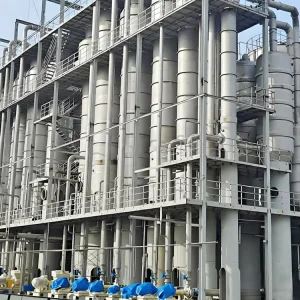
The fundamental difference between these technologies lies in the fluid dynamics within the heat exchanger tubes. In a falling film evaporator, the feed liquid is introduced at the top of the heating chamber, where a high-precision distribution system distributes it uniformly across the inner surfaces of the vertical tubes. Gravity pulls the liquid downward, forming a thin, continuous film that boils rapidly due to external steam heating. The co-current flow of vapor and liquid creates shear stress, accelerating the film velocity and resulting in exceptionally high heat transfer coefficients ($U$-values ranging from $2000$ to $4000 \text{ W/m}^2\text{K}$) and extremely short residence times (often measured in seconds). This makes falling film systems ideal for highly heat-sensitive media such as fruit juices, dairy products, and pharmaceuticals.
Operates on the thermosiphon principle. Liquid enters the bottom of the tubes; as boiling begins, vapor bubbles expand rapidly, lifting the liquid upward as a thin film along the tube walls. Best suited for low-to-medium viscosity liquids with moderate temperature differences.
Driven by gravity and vapor shear. Liquid flows downward from the top distribution plate. Offers superior heat transfer rates, minimal pressure drop, and handles highly heat-sensitive materials with minimal thermal degradation.
Conversely, a rising film evaporator operates on the thermosiphon principle. The liquid enters the bottom of the heating tubes and, as it absorbs heat, begins to boil. The generated vapor expands rapidly, forming bubbles that merge into a continuous vapor core. This upward-rushing vapor forces the remaining liquid to climb the inner walls of the tubes as a thin film. Rising film evaporators are highly effective for low-viscosity applications and processes where a significant temperature difference ($\Delta T$) is available to drive the thermosiphon effect.
The Hybrid Advantage: By combining both principles into a single system—a Rising and Falling Film Evaporator—engineers can process feeds that undergo dramatic viscosity changes. The rising film section handles the initial preheating and boiling phase, while the falling film section manages the high-concentration, high-viscosity phase, preventing tube dry-out and fouling.
For global industrial operators, compliance with international safety and quality standards is non-negotiable. Evaporation plants operate under varying pressure and temperature conditions, classifying them as pressure vessels. In the European Economic Area (EEA) and other global markets recognizing European standards, CE Certification under the Pressure Equipment Directive (PED) 2014/68/EU is mandatory.
Jiangsu Zongheng's commitment to compliance is demonstrated by our comprehensive certification portfolio. The PED compliance process involves rigorous design verification, material traceability, and non-destructive testing (NDT). Every weld joint undergoes radiographic or ultrasonic testing to ensure structural integrity under cyclic thermal stresses. Our manufacturing processes align with harmonized standards such as EN 13445 (Unfired Pressure Vessels) and the ASME Boiler and Pressure Vessel Code (ASME Section VIII, Division 1), symbolized by our ASME "U" Stamp authorization.
CE certification ensures that the evaporator's safety accessories—such as pressure relief valves, rupture discs, and automated safety instrumented systems (SIS)—are integrated to prevent over-pressurization. This level of compliance guarantees that our systems meet the safety and reliability requirements of multinational procurement teams.
Modern industrial plants face intense pressure to reduce energy consumption and carbon emissions. The thermal evaporation process is historically energy-intensive, requiring substantial steam inputs. To address this, Jiangsu Zongheng integrates advanced energy-saving technologies into our evaporator systems:
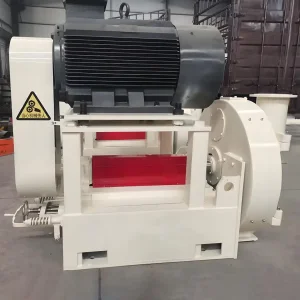
MVR technology represents the state-of-the-art in thermal efficiency. Instead of condensing the waste vapor generated during evaporation, an MVR system uses a mechanical compressor (either a centrifugal fan or a high-speed turbo compressor) to compress the vapor. This compression raises the temperature and pressure of the vapor, allowing it to be recycled back into the heating side of the evaporator as the primary heating medium.
By recycling the latent heat of vaporization, MVR systems reduce steam consumption by up to 90% compared to single-effect evaporators. The electrical energy required to run the compressor is a fraction of the thermal energy that would otherwise be discarded, resulting in an exceptionally low Coefficient of Performance (COP) and rapid return on investment (ROI).
For applications where electrical costs are high or steam is readily available, Multiple-Effect Evaporators (MEE) offer a highly optimized alternative. By cascading the vapor from one effect to heat the next effect operating at a lower boiling pressure, steam economy is multiplied. The addition of a Thermal Vapor Recompressor (TVR)—which uses high-pressure motive steam to entrain and compress a portion of the suction vapor—further enhances thermal efficiency, achieving steam economies of 1:6 or higher in a six-effect system.
Jiangsu Zongheng's evaporation and drying technologies are engineered to solve complex process challenges across diverse industrial sectors:
Concentrating corn steep liquor, glucose, maltose, and fructose syrups. Our falling film evaporators maintain precise temperature control to prevent caramelization and color formation, ensuring high product purity and clarity.
Processing thin stillage in bioethanol plants. Our waste heat evaporators utilize flash vapor from dryers and distillation columns, reducing fresh steam consumption while concentrating stillage for DDGS production.
Concentrating high-salinity industrial wastewater to crystallization limits. Our forced circulation and falling film systems handle corrosive salts (NaCl, Na2SO4) using corrosion-resistant alloys like Titanium and Duplex Stainless Steel.
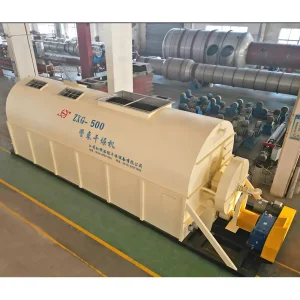
In the starch industry, our YDX Starch Washing Cyclone and ZXG Tube Bundle Dryers work in tandem with our evaporation plants. The wash water from the cyclone system, rich in soluble proteins and starches, is concentrated in our falling film evaporators to recover valuable by-products, while the tube bundle dryers handle the dewatered solids, creating a closed-loop, zero-waste manufacturing cycle.
Established in 1992, Jiangsu Zongheng has evolved from a local machinery manufacturer into a modern, high-tech enterprise. Located in Zhoutie Town, Yixing City, on the shores of Taihu Lake, our facility spans over 54,000 square meters, with a dedicated production workshop area of 22,000 square meters.
Our manufacturing capability is anchored by advanced fabrication technologies, including automated plasma cutting systems, CNC plate rolling machines, orbital tube-to-tubesheet welding robots, and large-scale heat treatment furnaces. These technologies ensure precise tolerances and weld quality, which are critical for maintaining vacuum integrity in falling film evaporators.
By maintaining complete control over the manufacturing process—from raw material sourcing (utilizing certified mills for SS304, SS316L, SAF2205, and Titanium) to final assembly and testing—we mitigate supply chain risks. Our strategic location in the Yangtze River Delta provides access to logistics networks, enabling efficient delivery of large-scale equipment to global ports.
Procuring a custom-engineered evaporation or drying system requires collaboration between the client's engineering team and the manufacturer. Jiangsu Zongheng supports global procurement teams through a structured project lifecycle:
1. Process Simulation & Pilot Testing: Using advanced thermodynamic simulation software, we model the evaporation process based on the client's specific feed analysis. When necessary, pilot-scale testing is conducted to verify heat transfer coefficients and fouling rates.
2. Mechanical Design & FEA: Our engineering team utilizes Finite Element Analysis (FEA) to design pressure vessels that comply with ASME, CE-PED, or GB standards, optimizing material thickness for safety and cost-efficiency.
3. Quality Assurance & Documentation: We provide a comprehensive documentation package, including material test reports (MTRs), weld maps, NDT records, hydrostatic test certificates, and CE Declaration of Conformity.
4. Commissioning & Localized Support: Our field service engineers provide on-site installation supervision, commissioning, and operator training. Through remote diagnostic modules integrated into our control panels, our engineers can assist with troubleshooting and process optimization globally.
Years of Industry Experience
Factory Area (m²)
Production Workshop (m²)
Senior & Process Engineers
Established as Yixing Yangxi Light Industrial Machinery Factory, starting with 45 employees and a focus on basic concentration equipment.
Obtained ISO9001 Quality Management System Certification, establishing international quality standards across all manufacturing lines.
Acquired the Special Equipment Manufacturing License of the People's Republic of China for pressure vessel fabrication.
Authorized to use the ASME "U" Stamp, marking our entry into high-end global industrial equipment supply.
Operating a 54,000 m² modern facility with over 120 employees, delivering advanced MVR and CE-certified evaporation systems worldwide.
Contact our engineering team today to design a custom, CE-certified rising and falling film evaporation system tailored to your production requirements.
Request a Technical Consultation Zongheng