In modern process engineering, thermal separation and concentration are critical operations across the food, pharmaceutical, chemical, and wastewater treatment sectors. Selecting the appropriate thermal technology requires a deep understanding of fluid dynamics, heat transfer coefficients, and product characteristics. Among the most widely adopted technologies are Falling Film Evaporators and Rising Film Evaporators. Both utilize tubular heat exchangers but operate on fundamentally different physical principles to achieve concentration.
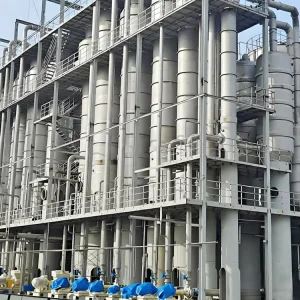
A falling film evaporator is engineered to process heat-sensitive liquids by distributing the feed liquid evenly across the top of vertical tubes. The liquid enters the distribution head, where it is precisely metered to form a thin, uniform film flowing downward along the inner walls of the heating tubes under the force of gravity. As the film descends, it absorbs heat from the external steam jacket, causing rapid partial vaporization.
The co-current flow of the vapor and the liquid film creates a shear force that accelerates the liquid downward, minimizing the boundary layer thickness and maximizing the heat transfer coefficient. This mechanism ensures an extremely short residence time (often measured in seconds) and operates under vacuum to lower the boiling point. Consequently, falling film evaporators are the industry standard for highly heat-sensitive materials, such as dairy products, fruit juices, pharmaceuticals, and organic solvents, where thermal degradation must be strictly avoided.
Key Design Challenge: The performance of a falling film evaporator hinges entirely on the liquid distribution system. Incomplete wetting of the tube surfaces leads to dry spots, which cause localized overheating, product degradation, and rapid fouling (scaling). Our engineering team utilizes advanced CFD modeling to design distribution plates that guarantee 100% wetting rates under variable feed conditions.
Conversely, a rising film (climbing film) evaporator operates on a thermo-siphon principle. The feed liquid enters the bottom of the heating tubes and is heated by the steam outside the tubes. As boiling begins, vapor bubbles form and rise rapidly. Due to the buoyancy and expansion of the vapor, a high-velocity vapor core is established in the center of the tube, dragging the liquid upward as a thin film along the tube walls.
This upward movement creates high turbulence, which is highly beneficial for processing liquids that have a moderate tendency to scale or have higher viscosities than typical falling film feeds. Rising film evaporators require a higher temperature difference (ΔT) between the heating medium and the boiling liquid to generate sufficient vapor velocity to lift the liquid film. While the residence time is slightly longer than in falling film systems, rising film units are highly effective for concentrating effluents, starch derivatives, and chemical solutions where space constraints favor a bottom-feed design.
For global procurement, compliance with international safety and quality standards is non-negotiable. Our evaporators are fully certified under the European Union's Pressure Equipment Directive (PED) 2014/68/EU, carrying the CE mark. This certification ensures that every pressure vessel, flange, and weldment meets rigorous safety criteria, including finite element analysis (FEA) for stress distribution, non-destructive testing (NDT) such as radiographic and ultrasonic inspections, and hydrostatic pressure testing.
Additionally, our manufacturing facilities hold the prestigious ASME "U" Stamp authorization, aligning our production with North American standards. This dual compliance framework guarantees that our systems can be seamlessly integrated into industrial plants worldwide, passing local regulatory inspections without delay.
A quick reference guide for process engineers selecting evaporator configurations.
Our systems are backed by rigorous international certifications.
With rising energy costs and strict carbon neutrality mandates, global buyers are transitioning away from traditional steam-driven multi-effect evaporators. Integrating Mechanical Vapor Recompression (MVR) technology allows the system to compress and reuse the secondary vapor, reducing thermal energy consumption by up to 90%. Our CE-certified falling film evaporators are optimized for MVR pairing, delivering rapid ROI.
Environmental regulations worldwide now enforce strict wastewater discharge limits. Evaporation is the cornerstone of Zero Liquid Discharge (ZLD) systems. By combining falling film evaporators for initial concentration with forced circulation crystallizers for final salt recovery, we provide macro solutions that enable factories to recycle 98% of process water while recovering valuable solid byproducts.
Procuring heavy industrial equipment requires reliable localized support. Our service model includes pre-commissioning pilot tests, localized installation supervision, and remote digital diagnostics. We ensure that spare parts, such as distribution plates, gaskets, and heat exchanger tubes, are readily available to minimize unplanned downtime for our global partners.
Modern processing plants require fully automated control systems. Our evaporators are equipped with Siemens or Allen-Bradley PLC systems, featuring real-time monitoring of boiling points, feed rates, vacuum levels, and cleaning-in-place (CIP) cycles. This level of automation prevents scaling, optimizes steam consumption, and ensures consistent product quality.
Founded in 1992 (formerly Yixing Yangxi Light Industry Machinery Factory), Jiangsu Zongheng has evolved into a modern high-tech enterprise specializing in the design, fabrication, and optimization of concentration, drying, and starch processing equipment. Located in Zhoutie Town, Yixing City, on the shores of Taihu Lake, our state-of-the-art manufacturing facility spans over 54,000 square meters, with a dedicated production workshop area exceeding 22,000 square meters.
As an active member of the China Starch and Alcohol Association, our products are widely utilized in food fermentation, bio-ethanol, chemical processing, pharmaceuticals, and environmental protection sectors. We are committed to delivering high-performance thermal solutions that comply with global standards, including CE and ASME certifications.
Operating with 120+ staff, including 3 senior engineers and 20+ specialized engineers, serving global markets.
Obtained international quality system certification (Certificate No. 45021), aligning processes with global standards.
Authorized to manufacture pressure vessels in compliance with ASME Section VIII Division 1.
Founded as Yixing Yangxi Light Industrial Machinery Factory, starting our journey in thermal engineering.
As industries face stricter environmental and economic pressures, the technology behind falling film and rising film evaporators must evolve. Jiangsu Zongheng is actively investing in research and development to pioneer the next generation of thermal concentration systems. Our technical roadmap focuses on three primary pillars:
Fouling remains the primary cause of efficiency loss in heat exchangers. We are collaborating with materials science institutes to develop hydrophobic and nano-structured tube coatings. These surface modifications reduce the adhesion of organic proteins and inorganic salts, extending operational run-times between CIP cycles by up to 40% and reducing chemical consumption during cleaning.
To process complex fluids that exhibit non-Newtonian behavior or undergo extreme viscosity changes during concentration, we are designing hybrid evaporators. These systems utilize a rising film configuration in the initial stage to handle low-viscosity feed, transitioning to a falling film configuration as the concentration increases, optimizing heat transfer across the entire concentration gradient.
By integrating IoT sensors into our CE-certified systems, we are enabling predictive maintenance capabilities. Our control software analyzes temperature differentials, pressure drops, and flow rates in real-time to predict scaling events before they impact production. This allows operators to schedule maintenance proactively, preventing costly unscheduled shutdowns.
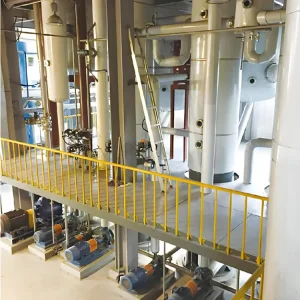
Partner with Jiangsu Zongheng for custom-engineered, CE-certified falling film and rising film evaporator systems. Contact our engineering team today for a detailed technical proposal.
Request a Technical Quote Zongheng