Description
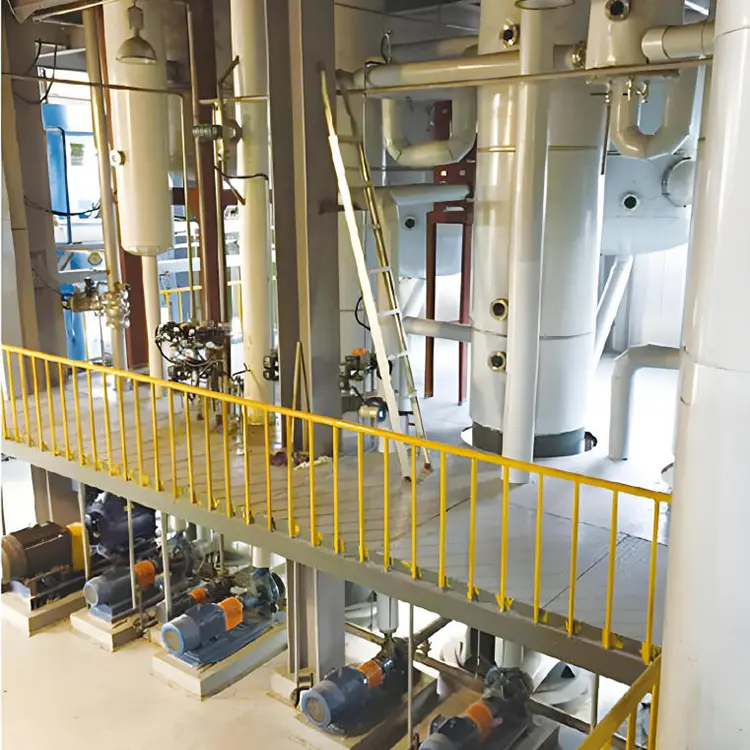
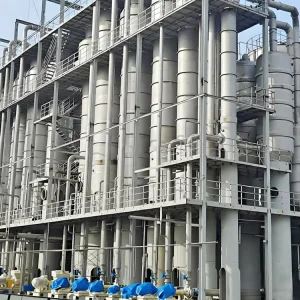
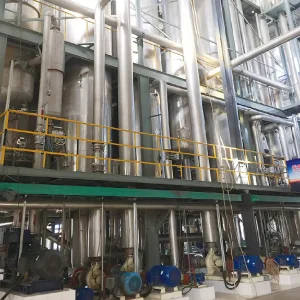
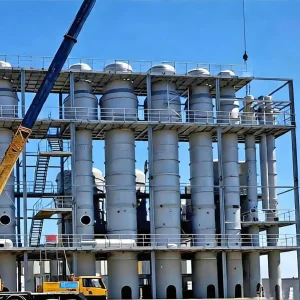
The liquid feed is introduced at the top of the calandria, where a distribution system ensures the formation of a uniform liquid film along the inner walls of the heating tubes. As the film flows downward under gravity, it is heated externally and begins to boil, partially evaporating along its path. The downward flow is further promoted by the co-current flow of vapor generated during boiling.
Separation of the remaining liquid film and vapor takes place in the lower section of the calandria and is completed in a downstream centrifugal droplet separator. To prevent dry spots—which can cause fouling and deposit accumulation—it is critical to maintain complete and even wetting of the entire heating surface. This can be achieved by using longer heating tubes, dividing the evaporator into multiple compartments, or implementing product recirculation.
Frequently Asked Questions
❓How does a falling film evaporator work?
In a falling film evaporator, liquid feed is introduced at the top of the calandria and distributed evenly as a thin film along the inner walls of vertical heating tubes. As the film flows downward under gravity, it is heated externally and partially evaporates. The resulting vapor and remaining liquid are then separated in the lower section and a downstream centrifugal droplet separator.
❓What products are best suited for falling film evaporation?
Falling film evaporators are particularly well-suited for temperature-sensitive products such as dairy products, fruit juices, plant extracts, sugar solutions, and blood plasma. They are also effective for liquids containing small quantities of solids with a low to moderate tendency to form incrustations.
❓How can fouling and dry spots be prevented in a falling film evaporator?
To prevent dry spots and fouling, it is essential to maintain complete and even wetting of the entire heating surface. This can be achieved by using longer heating tubes, dividing the evaporator into multiple compartments, or implementing product recirculation to ensure continuous and uniform liquid film coverage.
❓What energy-saving technologies can be integrated with a falling film evaporator?
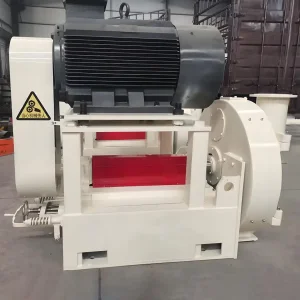
Falling film evaporators can be designed with advanced energy-saving technologies including multiple-effect evaporation, thermal vapor recompression (TVR), and mechanical vapor recompression (MVR). These integrations significantly reduce steam consumption and overall operational energy costs.
❓What international standards do the evaporators comply with?
The falling film evaporators are manufactured and tested in accordance with internationally recognized standards including ISO, CE, and ASME. Rigorous quality assurance and inspection processes are applied throughout production to ensure safety, performance, and global regulatory compliance.
❓Are customized falling film evaporation systems available?
Yes. Comprehensive customization and turnkey solutions are available, including tailored system design, layout optimization, and material selection to meet specific process requirements. Full end-to-end support is provided, covering everything from initial simulation and engineering to commissioning, operator training, and after-sales service.
 Zongheng