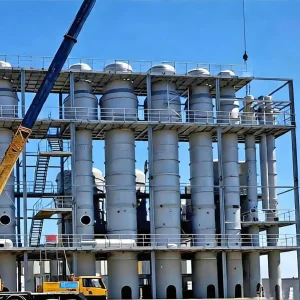
Industrial dairy processing operates under rigorous economic and ecological demands. High-quality milk evaporator machines serve as the core of powdered milk production lines, cheese processing plants, and condensed milk manufacturing facilities worldwide. To process heat-sensitive liquids like milk, specialized thermal processing is required to limit thermal degradation while maximizing water extraction. With global energy volatility and carbon neutrality goals tightening, standard thermal practices are evolving into intelligent, low-energy configurations like Mechanical Vapor Recompression (MVR) and multi-effect falling film evaporation systems.
Decarbonization Metric: Modern MVR evaporators reduce steam consumption by up to 90% compared to traditional 3-effect thermal evaporators, transforming raw waste steam into a viable heat source through mechanical compression cycles.
Dairy processors in North America, Western Europe, and Latin America evaluate thermal evaporation systems using strict selection criteria. Key purchasing goals include sanitary construction, cleaning flexibility, operating expenditures (OPEX), and mechanical reliability. Processing milk requires dealing with whey proteins, lactose, and minerals that can foul heat transfer tubes. To minimize cleaning downtime, manufacturers look for equipment with optimized liquid distribution, smooth internal tube finishes, and robust Clean-in-Place (CIP) systems.
Additionally, modern plants focus heavily on compliance. Equipment must adhere to regional sanitary requirements, such as 3-A Sanitary Standards in the United States and EHEDG guidelines in Europe. For high-pressure vessels, manufacturers look for ASME Section VIII Division 1 or European Pressure Equipment Directive (PED 2014/68/EU) certifications to guarantee structural integrity under continuous vacuum pressure.
Depending on the feed properties, volume, and plant utility profile, dairy and chemical manufacturers utilize different technological routes:
| Evaporator Type | Primary Mechanism | Thermal Efficiency | Key Application |
|---|---|---|---|
| Falling Film Evaporator | Gravity-induced thin film distribution down vertical tubes. | High (with TVR or steam economy) | Skim and whole milk, whey proteins, juice concentration. |
| MVR Evaporation Plant | Mechanical compressor recycles waste vapor by raising temperature. | Ultra-High (Lowest OPEX) | Continuous large-scale dairy concentration, chemical wastewater. |
| Forced Circulation | High-velocity recirculation pump prevents tube surface fouling. | Moderate (High power use) | High-viscosity liquids, crystallization, starch washing. |
| Waste Heat Evaporator | Utilizes flash steam or dryer exhausts as primary heating source. | Excellent (Zero fuel cost) | DDGS processing, corn steep liquor, starch processing. |
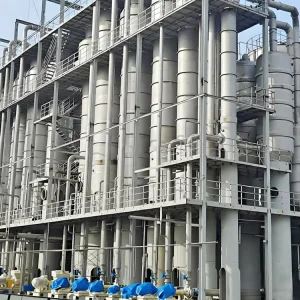
The Falling Film Evaporation Plant concentrates heat-sensitive liquids by introducing the feed liquid at the top of vertical tubes. Using a distribution plate, it flows downward as a thin film along the inner tube walls. Steam or compressed vapor heating the tube exterior causes the falling liquid film to boil. The resulting vapor and concentrated liquid flow downward together, creating a co-current shear that reduces resident time. Keeping the product inside the heated zone for only seconds protects delicate dairy proteins from denaturing and preserves the product's natural color and nutritional profile.
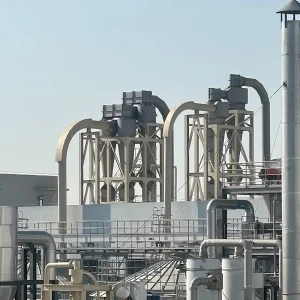
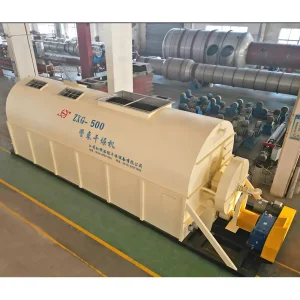
For auxiliary drying tasks, systems like the MQG Airflow Dryer utilize high-velocity hot air to fluidize wet solids, using varying tube diameters to create pressure differentials. This continuous turbulence ensures rapid heat transfer and drying as particles are transported through the loop, making it ideal for processing feed starches, bypass proteins, and chemical cake materials. To dry denser materials like corn fiber or DDGS grains, the ZXG Tube Bundle Dryer uses an indirect steam-heated design. Here, wet materials contact rotating tubes under low-oxygen conditions, yielding uniform drying with low thermal losses.
MVR, Falling Film, and Forced Circulation systems designed for high solids concentration and low energy use.
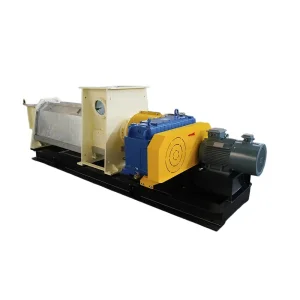
Single Screw Presses providing continuous mechanical liquid-solid separation for fibrous agricultural byproducts.
ZXG Tube Bundle and MQG Airflow systems for safe, indirect steam-based mass transfer and moisture control.
Established as Yixing Yangxi Light Industrial Machinery Factory, covering 15 mu of land with 45 employees, focusing on localized fabrication of light process equipment.
Obtained ISO9001 certification, standardizing internal quality management systems and expanding production processes.
Recognized as a Jiangsu Provincial High-Tech Enterprise, increasing investment in industrial energy conservation R&D.
Obtained the Special Equipment Manufacturing License of the People's Republic of China, certifying the factory for medium and low-pressure vessel production.
Acquired the ASME "U" Stamp authorization, aligning engineering designs with global pressure vessel standards.
Secured international quality system certification, expanding operations into overseas chemical and dairy projects.
Currently operating out of a 54,000+ sqm facility with a 22,000+ sqm production plant, employing over 20 specialized engineers to deliver integrated process lines.
MVR (Mechanical Vapor Recompression) systems compress the clean steam produced during evaporation, increasing its temperature and pressure. This compressed steam is then cycled back as the primary heating source for the evaporator tubes. This process eliminates the need for a continuous external live steam supply, lowering utility consumption and reducing CO2 emissions compared to direct thermal designs.
Fouling is controlled using structured liquid distribution systems at the top of the tube bundle. This ensures a consistent, continuous liquid film flows down each tube. Regular wet-wall operations prevent dry spots where lactose carmelization or protein denaturation could occur. System runs are also supported by automated Clean-in-Place (CIP) regimes.
All product-contact parts are fabricated from sanitary-grade stainless steel, typically AISI 304 or AISI 316L. Internal surfaces are polished to a roughness average (Ra) of < 0.8 µm to prevent bacterial adhesion and ensure efficient cleaning during wash cycles.
Yes. For high-viscosity liquids or concentrates containing suspended crystals, we recommend Forced Circulation Evaporators. High-capacity pumps circulate the product at high velocities through the heat exchanger tubes, creating shear stress that prevents tube fouling and helps maintain steady heat transfer rates.
Jiangsu Zongheng holds both ISO9001 and ASME "U" Stamp certifications, and manufactures pressure equipment in compliance with CE-PED requirements. This enables us to design, fabricate, and export industrial-grade Category III pressure vessels for dairy and starch processing plants worldwide.
Need custom evaporator sizing calculations or energy consumption projections for your plant?
Get in touch with our engineering team in Yixing, China, to learn more about our manufacturing capabilities and schedule a facility visit.
 Zongheng