Modern process manufacturing relies heavily on efficient dewatering and moisture management. Across international chemical processing, food fermentation, alcohol production (DDGS), starch refining, and pharmaceuticals, drying operations represent a large portion of a facility's total energy footprint. As environmental regulations tighten and energy costs remain volatile, the global industrial sector is shifting away from inefficient, high-emission thermal drying systems in favor of closed-loop, low-oxygen, and vapor-recompression architectures.
Industrial airflow dryers and tube bundle drying systems are essential for processing bulky agricultural materials, minerals, and organic residues. Global manufacturers need machines that prevent product oxidation, handle high moisture variations, and run continuously with minimal downtime. Selecting the right equipment manufacturer requires evaluating thermal efficiency, compliance with international pressure codes (such as ASME and CE), and the integration of energy-saving designs like Mechanical Vapor Recompression (MVR).
"The modern standard for drying technology requires high-performance heat exchange and low energy consumption. Designing systems that capture latent heat while protecting products from thermal degradation is the benchmark for industrial drying manufacturers."
For operations in North America, Europe, and Asia-Pacific, buying capital-intensive drying and concentration systems involves evaluating long-term operational costs (OPEX) alongside initial capital costs (CAPEX). Reliable manufacturers build industrial dryers using high-grade alloys (such as SUS304, SUS316L, and Duplex Stainless Steels) and incorporate smart PLC control systems. This balances durability with precise thermal control to prevent fouling and degradation of sensitive materials.
Mechanical Vapor Recompression (MVR) systems compress evaporated vapor to raise its temperature and reuse it as the heating medium. This lowers steam consumption and cuts down utility costs in concentration plants.
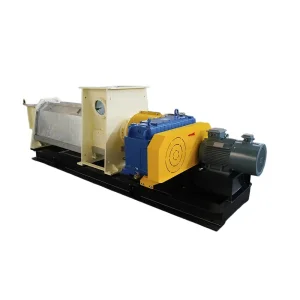
Using mechanical compression, our Single Screw Presses squeeze water out of high-moisture organic and inorganic solids before thermal drying. This reduces the energy needed for final evaporation.
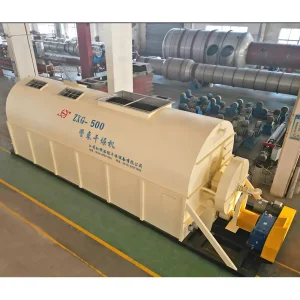
Our tube bundle drying system uses indirect steam to dry heat-sensitive residues under low oxygen levels. This prevents material oxidation, minimizes dust, and reduces fire risks.
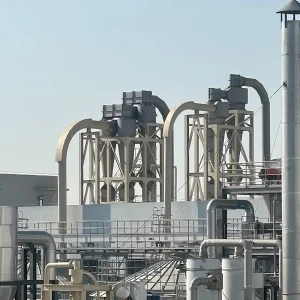
Industrial Airflow Dryers (MQG Series): Airflow dryers suspend wet materials in a high-velocity hot air stream. The MQG series uses varied tube diameters to create pressure drops. This creates turbulence that breaks up particles, dries them uniformly, and carries them through the system in seconds. It is ideal for materials like starch, protein powders, and food fiber residues.
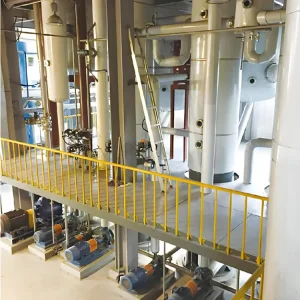
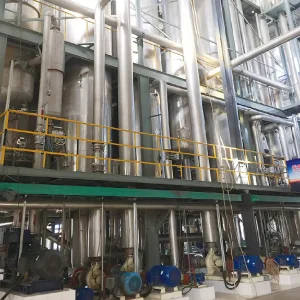
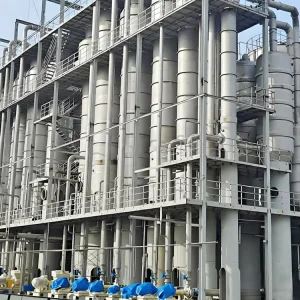
Falling Film Evaporators: Designed for heat-sensitive liquids, a falling film evaporator feeds liquid into the top of vertical tubes, where it flows down as a thin film. Part of the liquid evaporates instantly, and the vapor flows alongside the liquid to speed up heat transfer. This keeps residence times short and temperatures low to prevent thermal degradation.
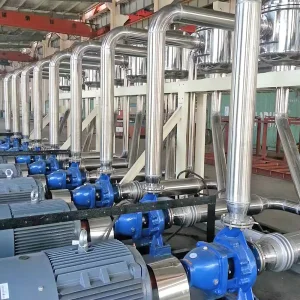
Forced Circulation Evaporators: For highly viscous liquids, crystallizing solutions, or wastewater containing high solids, forced circulation plants use high-capacity pumps to keep fluid moving rapidly through the heat exchanger. The high velocity prevents fouling and scaling on the heat transfer tubes, ensuring stable performance during wastewater concentration and zero-liquid discharge (ZLD) operations.
Modern industrial drying plants focus on maximizing energy recovery. Relying solely on fossil-fuel steam generators is no longer cost-effective. The integration of drying and concentration equipment in a single facility allows for smart energy sharing: waste heat from dryer exhausts can run concentration plants, and condensed water can be recycled back into the system.
Drying systems produce warm, moisture-heavy exhaust air. Instead of venting this directly to the atmosphere, we route it through corrosion-resistant heat exchangers to preheat feed liquids or run low-temperature evaporators. This design recovers valuable latent heat, reducing overall fuel demand.
For solvent-based processes or materials prone to oxidation, closed-loop systems use inert nitrogen as the drying gas. The nitrogen carries evaporated moisture to a condenser, where the liquids separate out. The dry nitrogen is then reheated and returned to the dryer, creating a safe, zero-emission process.
By using Mechanical Vapor Recompression (MVR) systems alongside airflow dryers, processing plants can reduce steam usage by up to 90% compared to traditional multi-effect evaporators. Although the upfront cost for MVR compressors is higher, the energy savings typically pay for the investment within 12 to 24 months of continuous operation.
In Yixing City, Jiangsu Province, China, Jiangsu Zongheng Concentrating and Drying Equipment Co., Ltd. (formerly Yixing Yangxi Light Industry Machinery Factory) runs a large-scale manufacturing operation. Founded in 1992, the company has expanded to cover over 54,000 square meters, with more than 22,000 square meters of production workshops. Located in Zhoutie Town along Taihu Lake, our facility benefits from a strong local industrial supply chain.
Yixing is a major hub for raw material sourcing, precision machining, and specialized welding. We source high-grade steel plate, tubing, and automated control systems locally, which lowers transport costs and speeds up production. Our advanced workshops feature heavy rolling mills, automated tube-to-tubesheet orbital welding machines, and dedicated rooms for non-destructive testing (NDT), ensuring all industrial dryers and evaporators are built to last.
Our dedicated engineering department coordinates design, procurement, and fabrication, allowing us to manage large orders efficiently. By handling machining, assembly, polishing, and quality inspections in-house, we control costs and keep production times short, even when customizing systems for international clients.
Concentration and drying systems often operate under high pressures and temperatures, making international safety compliance essential. Jiangsu Zongheng maintains a strict quality control system to ensure our machinery meets the regulatory standards of different export markets.
Certified since 2012 to design and manufacture pressure vessels that meet the ASME Boiler and Pressure Vessel Code (Section VIII, Division 1) for the American market.
ISO 9001 certified since 2002. Our engineering, raw material inspections, production processes, and pressure tests are fully documented and traceable.
Holds Class III pressure vessel design and manufacturing qualifications (License No.: TS2232C42) issued by the state authorities.
Every evaporator and industrial dryer we build undergoes non-destructive testing (NDT), including radiographic, ultrasonic, magnetic particle, and liquid penetrant testing. We also perform hydrostatic and pneumatic pressure tests witnessed by authorized inspectors to verify weld strength and vessel integrity before shipment.
Today, the company covers a total area of over 54,000 square meters, with production workshop space exceeding 22,000 square meters. It currently employs 3 senior engineers and over 20 engineers and assistant engineers, with a total staff of 120 people.
Obtained International Quality System certification (Certificate No.: 45021), establishing a complete quality assurance system aligned with international standards.
Acquired the ASME "U" Stamp authorization, marking the company's entry into a new phase of development.
The company obtained the Special Equipment Manufacturing License of the People's Republic of China (License No.: TS2232C42).
Recognized as a Jiangsu Provincial High-Tech Enterprise, highlighting our commitment to R&D and technical innovation.
The company took the lead in obtaining ISO9001, setting a high standard for manufacturing quality controls.
Jiangsu Zongheng Concentrating and Drying Equipment Co., Ltd (formerly known as Yixing Yangxi Light Industrial Machinery Factory) was established with a total area of approximately 15 mu and a staff of 45 employees.
Connect with our engineering team to design custom thermal solutions, specify ASME pressure vessels, or request a quote for your project.
Request Technical Quote
 Zongheng