Industrial evaporation technologies have entered a paradigm-shifting era driven by two core global imperatives: energy decarbonization and strict environmental regulatory alignment. Historically, evaporation was treated purely as an operational thermal separation step. Today, it stands as the critical pivot for industrial zero liquid discharge (ZLD) strategies, volatile compound recovery, and plant energy loop integration.
In modern chemical synthesis, food processing, and grain refinery landscapes, the selection of thermal concentration equipment is no longer limited to basic boil-off configurations. Advanced configurations like Mechanical Vapor Recompression (MVR) and multi-effect falling film evaporation plants have redefined thermodynamic efficiency. By recovering the latent heat of vaporization from the secondary steam and compressing it to higher thermal states, companies can achieve over a 70% reduction in utilities compared to traditional single-effect configurations.
International manufacturing enterprises—particularly in Europe, North America, and Southeast Asia—prioritize long-term operational expenditure (OPEX) calculations over initial capital expenditure (CAPEX). This shift has led to specific procurement guidelines:
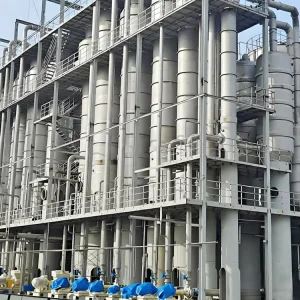
Specially engineered for highly heat-sensitive fluids. Liquid forms a continuous, gravity-driven thin film down the inner walls of vertical heat exchange tubes. This guarantees remarkably short residence times and minimal thermal degradation, making it ideal for food, starch, and pharmaceutical refining applications.
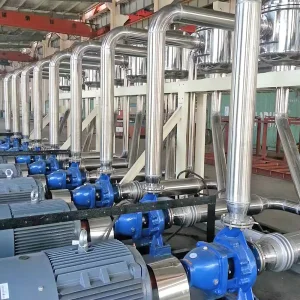
Designed to process high-fouling, viscous, or crystallizing solutions. High-capacity axial flow pumps maintain high fluid velocities inside the heat exchanger, preventing premature boiling inside the tubes and suppressing solid deposition on heat-transfer surfaces.
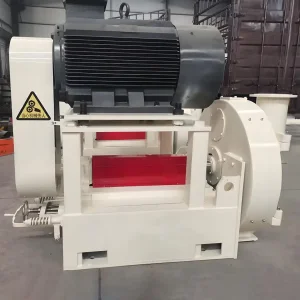
Mechanical Vapor Recompression stands at the absolute vanguard of green energy technology. By compressing secondary vapors using centrifugal fans or high-speed turbo blowers, the system elevates steam enthalpy to reuse it as the primary heating medium, drastically slashing steam demands.
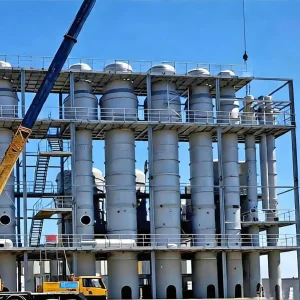
An ideal system integration choice for plants featuring industrial dryers or boilers. This technology recovers flue gas energy, low-temperature boiler vapors, and dryer emissions to drive multi-effect processes, ensuring zero fuel wastage and exceptional thermal optimization.
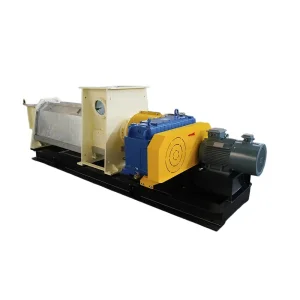
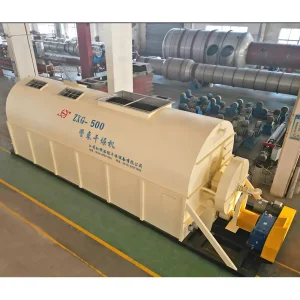
Operating as an indirect contact heat transfer drying system, it maintains low oxygen levels internally to protect combustible organic residues. Ideal for processing high-density biological bulk materials such as DDGS (Distillers Dried Grains with Solubles) and starches.
Utilizes high-speed dynamic warm air to suspend, fluidize, and transport wet particles. Varying pipe designs cause instant pressure drops and mechanical turbulence, maximizing active heat exchange area and producing dry powders within seconds.
Industrial evaporation technologies are highly customized systems configured to the physicochemical properties of the process fluid. As a high-capacity engineering manufacturer, Jiangsu Zongheng structures its solutions around specific vertical sectors, offering complete process lines from dewatering to evaporation and final drying.
In corn processing and maize milling factories, the integration of Zongheng Degerming Mill Machines and YDX Starch Washing Cyclones ensures that raw materials are refined to optimal purity before entering downstream chemical or thermal processes. Our washing cyclones rely on multi-stage hydrocyclone configurations to remove fine impurities, producing highly concentrated starch milk. This starch milk can then be dried instantly using our industrial MQG Airflow Dryer series.
Manufacturing equipment for high-pressure or high-temperature environments demands extreme precision. Pressure vessels must comply with strict national and continental codes to guarantee plant safety.
Our pressure equipment complies fully with European CE directives (Directive 2014/68/EU), verifying safety standards for stress limits, pressure relief systems, and structural metallurgy. Additionally, our ASME "U" Stamp authorization, obtained in 2012, permits the fabrication of code-compliant high-pressure and low-pressure vessels, opening up major industrial doors across the Americas and globally.
Originally established as Yixing Yangxi Light Industry Machinery Factory, focusing on regional component manufacturing. The factory covered approximately 15 mu and employed 45 pioneering workers.
Implemented unified standard operating procedures, obtaining the ISO9001 standard certification to guarantee repeatable manufacturing tolerances.
Formally recognized as a Jiangsu Provincial High-Tech Enterprise, marking the transition from basic manufacturing to high-end R&D.
Obtained the Special Equipment Manufacturing License of the People's Republic of China (License No.: TS2232C42) for pressurized vessels.
Acquired the ASME "U" Stamp authorization, marking a major milestone for global export projects and high-pressure system safety compliance.
Established a complete international quality assurance system (Certificate No.: 45021) to meet demanding global engineering requirements.
Our modern footprint covers over 54,000 square meters, featuring a 22,000 square meter heavy production workshop, 23 senior and specialized engineers, and a total staff of 120 dedicated experts.
As industrial operators target net-zero emissions, the future of evaporation technology relies on integration with intelligent plant systems. The development path for the next decade centers on three core innovations:
Integrating IoT temperature, pressure, and flow sensors allows real-time thermal modeling. The digital twin predicts scaling rates within boiling channels, automatically adjusting feed flow or activating Clean-In-Place (CIP) sequences to optimize heat transfer efficiency.
Traditional evaporators require live steam. Next-generation MVR installations use all-electric high-ratio mechanical compressors, drawing power from renewable grids. This enables 100% steam-free concentration processes, aligning perfectly with carbon-neutral manufacturing initiatives.
Processing corrosive brines, organic acids, and pharmaceutical wastes requires advanced metallurgy. Incorporating titanium, duplex stainless steels (such as 2205 and 2507), and Hastelloy materials ensures system lifespans exceed 25 years, even under continuous operation.
CE certification indicates compliance with European safety, health, and environmental protection standards. For pressure vessels, this requires compliance with the Pressure Equipment Directive (PED 2014/68/EU). Without proper CE marking, systems cannot be legally operated in the European Economic Area (EEA). This certification ensures weld integrity, raw material traceability, safety valve performance, and pressure test verification.
MVR treats the secondary steam generated from evaporation as a heat source rather than condensing and discharging it. By passing this vapor through a mechanical compressor, its temperature and pressure rise. It is then cycled back into the heating side of the same evaporator. This loop eliminates the need for continuous live boiler steam, reducing energy costs by up to 60-80% compared to traditional multi-effect setups.
Preventing fouling relies on three main design factors: ensuring high, uniform liquid distribution across all tubes, maintaining design-critical falling film velocities, and using polished, electro-cleaned heat exchange tubes. Automated CIP systems are also integrated to flush the system with diluted acids or bases at set intervals without requiring manual disassembly.
Yes. Our custom waste heat evaporators feature multi-manifold headers designed to collect heat from various waste streams simultaneously. This includes low-pressure steam, hot flash vapors, drier exhaust gas, and boiler blowdown water. The system balance is calculated via thermodynamics to maximize flash-evaporation yield from these variable heat inputs.
The ZXG Tube Bundle Dryer uses indirect contact heating via steam-fed internal tube bundles. This allows for closed-loop steam sweeps or inert nitrogen blanketing. Maintaining low oxygen levels within the drying chamber minimizes the risk of dust explosions or organic residue combustion, even when processing dry starches and alcohol DDGS at high temperatures.
 Zongheng