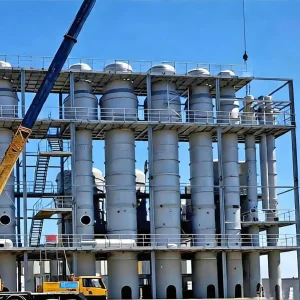
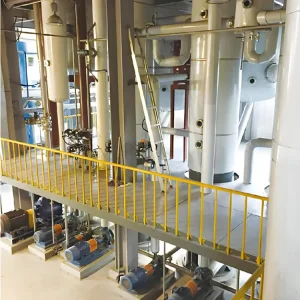
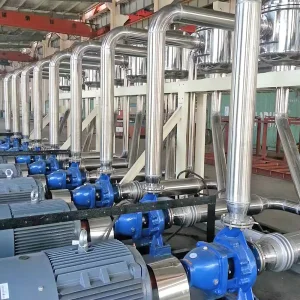
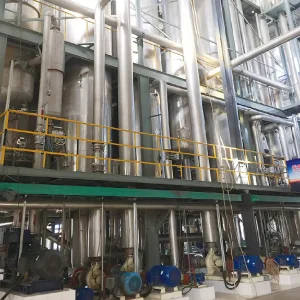
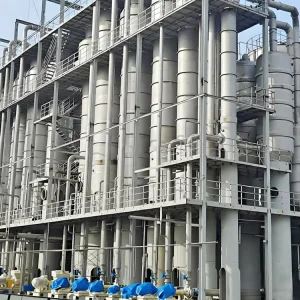
Industrial waste management requires highly advanced, energy-efficient thermal separation solutions to process complex wastewater. Falling film evaporators operate on the fundamental principle of gravitationally distributing feed liquid into a thin uniform film flowing down the inner surfaces of heated vertical tubes. As steam or vapor heat sources apply thermal energy to the outer tube walls, partial boiling occurs inside. The resulting vapor phase flows co-currently with the liquid phase, creating shear forces that enhance overall heat transfer coefficients.
By optimizing the hydraulic loading and utilizing mechanical vapor recompression (MVR) or thermal vapor recompression (TVR), process plants drastically decrease steam consumption. Preserving liquid film integrity is paramount; insufficient wetting rates trigger dry patches, causing localized fouling, scaling, and accelerated corrosion. Our designs mathematically balance tube lengths, vapor velocities, and liquid distribution systems to guarantee absolute structural integrity and maximum heat exchange efficiency.

By utilizing Multi-Effect systems and Waste Heat Integrations, we extract energy from lower-grade sources like drying vapors, drastically shrinking carbon footprint and system OPEX.
High recirculation rates in forced circulation units combat scaling, preventing localized precipitation when handling high-salinity or high-viscosity wastewater.
Specially customized material paths engineered with Duplex stainless steels, titanium alloys, or Hastelloy structures resist extreme chemical attacks in harsh operating environments.

Modern industrial targets demand a profound shift toward total decarbonization. Our engineering pipeline is heavily focused on the electrification of thermal concentration processes. Historically dependent on direct fossil steam sources, next-generation waste evaporators rely on mechanical vapor recompression (MVR) powered by renewable electricity. This method replaces high-carbon fossil fuels with compressed secondary steam recycling loops.
Concurrently, our systems incorporate AI-driven predictive control systems. By processing real-time sensor metrics (temperature deltas, flow viscosities, current draws, and sound frequencies from compressors), the algorithms dynamically predict crystallizing behaviors and heat transfer efficiency declines. This enables targeted, predictive CIP (Cleaning-in-Place) sequencing, reducing down-time by 35% and overall water consumption for maintenance by 40%.
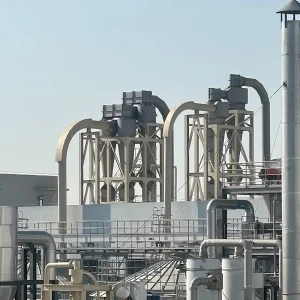
We deploy high-velocity cyclone washing and degerming mills in tandem with multi-stage evaporation systems. These integrate raw washing effluents with heat recycle paths to maximize dry-matter recovery from starch processing lines.
Concentrating high-organic vinasse streams requires heavy duty forced-circulation evaporators. Our custom configurations allow plants to achieve massive concentration targets, generating valuable DDGS feed bypass while reclaiming distillate waters.
Concentrating complex inorganic salts demands robust crystallization technologies. Our forced circulation evaporators are configured to operate reliably past raw saturation thresholds, depositing salts effectively while returning high-purity condensates.
For high-purity, heat-sensitive pharmaceutical intermediates, falling film evaporators guarantee minimum residence time and low temperature operation under deep vacuum conditions, preventing molecular breakdown.
Jiangsu Zongheng operates a modern high-tech production facility stretching over 54,000 square meters of overall industrial space, including an advanced production plant area of 22,000 square meters. Our factory is equipped with automated plasma arc cutting, CNC plate rolling, automated submerged arc welding systems, and class-leading non-destructive testing (NDT) rooms. This robust setup allows us to reliably fabricate Category III medium and low-pressure vessels and complex heat exchange apparatuses in-house.
By localizing the entire supply chain, from metallurgical sourcing to high-precision machining, we mitigate international supply blockages. This provides our global clients with predictable lead times, rigorous quality controls, and highly competitive capital expenditures (CAPEX) for heavy processing equipment.
Our facilities cover over 54,000 square meters of total area, with production workshop spaces exceeding 22,000 square meters. The engineering roster boasts 3 senior engineers and 20+ specialized engineers managing a production team of 120 skilled staff.
Obtained international quality system certification (Certificate No.: 45021), establishing a complete quality assurance system aligned with international standards.
Acquired the ASME "U" Stamp authorization, validating our thermal vessel design and fabrication capabilities to the highest global standards.
The company obtained the Special Equipment Manufacturing License of the People's Republic of China (License No.: TS2232C42) for manufacturing Class-III pressure vessels.
Officially recognized as a High-Tech Enterprise by the government, leading the region in energy-saving technology research.
Successfully integrated ISO9001 quality management structures into our production lines, establishing standardized manufacturing workflows.
Jiangsu Zongheng Concentrating and Drying Equipment Co., Ltd was founded as Yixing Yangxi Light Industry Machinery Factory in Zhoutie Town, Yixing City, with a team of 45 people.
Purchasing large-scale industrial thermal systems requires close alignment between process engineers, procurement teams, and fabricators. To ensure project success, global buyers should prioritize several key parameters during technical discussions:
Navigating global regulatory landscapes requires meticulous engineering compliance. Jiangsu Zongheng ensures that all pressure vessels, evaporators, and dryers conform to rigorous international testing protocols. Our internal quality control system is audited regularly for both ASME "U" Stamp and CE Directives. We manage the entire verification path in-house, covering metallurgical material tracing, non-destructive welding checks (RT, UT, MT, PT), and final hydrostatic pressure testing.
Additionally, we collaborate with localized service partners to provide technical assistance, field inspections, commissioning guidance, and maintenance support. Our remote diagnostics interface allows our engineering team to inspect MVR system operations, optimize PID control loops, and troubleshoot sensor issues from our headquarters.
Get in touch with our engineering team for customized thermal designs, mass balance simulations, and ROI evaluations.
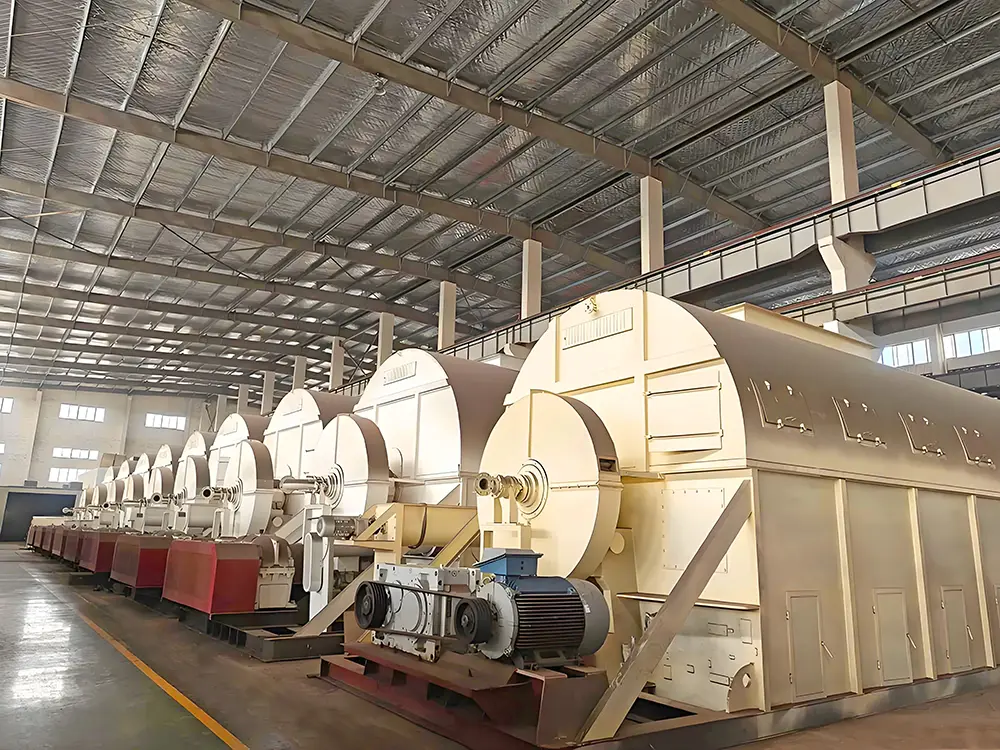
Download our technical catalogs for evaporators, screw presses, tube bundle dryers, and starch washing cyclones.
 Zongheng