China’s Waste Evaporator market serves factories facing a practical challenge: reducing liquid waste while recovering usable water. A reliable system must handle changing wastewater chemistry, not just perform well in a brochure. Operators inspect heat-transfer surfaces, clean deposits from evaporator tubes, and monitor condensate quality. Small details matter.
The need is substantial. UN-Water’s 2024 SDG 6 progress update reports that 42% of household wastewater worldwide was not safely treated in 2022, representing about 113 billion cubic metres. The UNESCO World Water Development Report 2017 also identified wastewater as an underused resource. These figures describe a global challenge, not demand for any single machine. Still, they explain why industrial buyers compare energy use, corrosion resistance, fouling control, and service support before choosing equipment.
This overview of top Waste Evaporator manufacturers in China should therefore focus on verifiable capabilities: documented operating cases, process range, materials, and after-sales response. A polished specification sheet is not enough. The difficult question is how a unit performs after months of real operation. No source material was provided to verify a direct quotation from a named Waste Evaporator expert, so assigning one here would risk misrepresentation. That gap deserves attention. Independent testing and customer references can help buyers separate demonstrated performance from marketing claims.
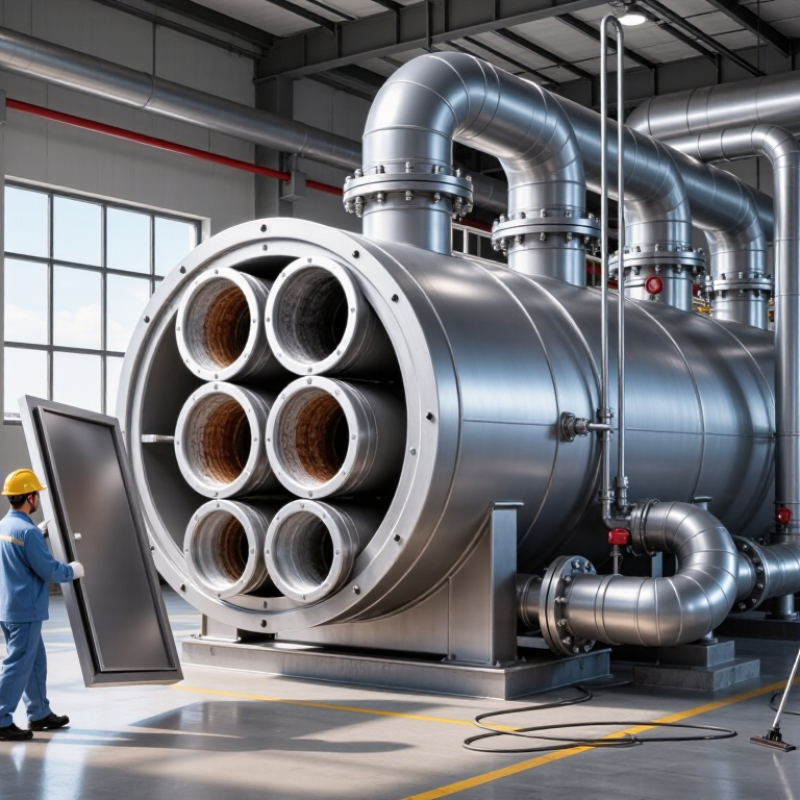
Waste evaporators reduce the liquid volume of industrial wastewater by separating water from dissolved or suspended material. The feed is heated until part of its water becomes vapor, leaving a more concentrated residual stream. That concentrate may need further treatment or disposal, depending on its composition and the facility’s process requirements. The vapor is usually condensed for reuse or managed as a separate stream. Simple in principle. Careful operation matters.
Heat may come from steam, electric elements, or recycled vapor in a multi-effect system. Operators monitor temperature, pressure, flow, and concentrate levels to keep evaporation stable. A change in feed can alter performance: oils may cause foaming, while mineral salts can form scale on heat-transfer surfaces. Cleaning schedules and feed checks help limit these problems, but they do not eliminate them. No unit fits every wastewater stream. Before selecting equipment, engineers should review wastewater samples, expected flow, energy availability, and the intended quality of recovered water. Real operating data is useful, yet early estimates can still miss seasonal changes or unexpected contaminants.
Waste evaporators remove water from liquid waste to reduce its volume and concentrate dissolved or suspended materials. The most suitable design depends on wastewater composition, scaling and corrosion risks, required concentration, energy availability, and the intended handling or treatment of the concentrate.
| Evaporator type | Core operating principle | Common wastewater applications | Key advantages | Important design considerations |
|---|---|---|---|---|
| Mechanical vapor recompression (MVR) | A compressor raises the pressure and temperature of generated vapor so it can be reused as the heating source for evaporation. | Industrial wastewater concentration and suitable process streams where recovered vapor can be reused. | Reuses latent heat and can reduce external heating demand compared with single-effect evaporation. | Requires electrical power for compression. Feed pretreatment, heat-transfer fouling, and vapor quality affect performance. |
| Multi-effect evaporation | Vapor produced in one effect supplies heat to another effect operating at a lower pressure and boiling temperature. | Continuous concentration duties with relatively steady feed and sufficient available steam or another heat source. | Uses the same heating vapor across multiple effects, improving steam utilization over a single-effect system. | More effects can increase equipment and control complexity. Scaling, boiling-point elevation, and temperature differences must be considered. |
| Vacuum evaporator | Reduced pressure lowers the boiling temperature, allowing evaporation at a lower temperature than at atmospheric pressure. | Heat-sensitive wastewater or streams for which lower-temperature processing is beneficial. | Can limit thermal exposure and may support recovery of condensate for further evaluation or reuse. | Needs a vacuum system and suitable vapor handling. Lower boiling temperature does not eliminate the need for heat input. |
| Forced-circulation evaporator | A pump circulates liquid at high velocity through a heat exchanger; vaporization generally occurs after the heated liquid enters a lower-pressure separator. | Concentrated, viscous, or scaling-prone process liquids, subject to appropriate materials and operating conditions. | High circulation can reduce localized boiling in the heat exchanger and help manage some fouling and crystallization duties. | Pumping adds power use. Abrasion, salt deposition, corrosion, and cleaning access need assessment for the specific feed. |
| Falling-film evaporator | Feed is distributed across heated tubes and flows downward as a thin film while part of the liquid evaporates. | Relatively clean, low-viscosity feeds that can be evenly distributed and are not strongly prone to scaling. | Short liquid residence time and a large heat-transfer area can suit temperature-sensitive, free-flowing liquids. | Even distribution is important. Suspended solids, high viscosity, or deposits can impair film formation and heat transfer. |
| Agitated thin-film evaporator | A rotor spreads liquid into a thin, continuously renewed film over a heated surface, promoting heat transfer and vapor removal. | High-viscosity or heat-sensitive concentrates that are difficult to process in conventional film equipment. | Short residence time and mechanical film renewal can help process viscous materials. | Moving parts increase maintenance needs. Suitability depends on solids, viscosity, abrasion, and the required throughput. |
| Evaluation dimension | What to verify |
|---|---|
| Feed characteristics | Flow rate, solids, viscosity, pH, dissolved salts, volatile compounds, and temperature sensitivity. |
| Materials and fouling | Compatibility of wetted materials with the feed, corrosion risks, scaling tendency, cleaning method, and maintenance access. |
| Energy and utilities | Available steam, electricity, cooling water, heat recovery opportunities, and the site's utility costs and limits. |
| Outputs and compliance | Expected condensate quality, concentrate quantity and handling route, emissions controls, and applicable discharge or reuse requirements. |
Performance and suitability depend on the actual wastewater and operating conditions. Pilot testing or a feed-specific process assessment may be needed before equipment selection.
Common options include multi-effect evaporation, mechanical vapor recompression, thermal vapor recompression, and vacuum evaporation. Each handles heat and wastewater differently.
It compresses secondary vapor and reuses its heat. This can reduce steam use, but electricity demand and compressor performance matter.
It uses a steam jet to recover vapor energy. It may suit plants with readily available steam. Not always.
It lowers boiling temperatures, which can help with heat-sensitive liquids. Feed solids, foaming, and corrosion may still affect the choice.
Check salts, organic matter, scaling risk, daily flow, and available heat. A jar sample can reveal suspended solids. Small details matter.
A small pilot run may reveal scaling that lab data misses. Crystals on heat-transfer surfaces are worth watching. A neat lab result can still mislead.
Chemical, pharmaceutical, electroplating, mining, textile-dyeing, and food-processing plants may use them. Their wastewater can include salty rinse water or spent cleaning liquids.
It may be added for high-salt streams after concentration. It can increase energy use and maintenance demands. More equipment is not always better.
Industry accounted for about 20% of global freshwater withdrawals, according to a 2024 report. China recorded 97.6 billion cubic metres of industrial water use in 2023. These figures show context, not sector-specific evaporation volumes.
Waste evaporators help reduce the volume of liquid waste by separating water from dissolved or suspended substances through controlled heating and vapor removal. Their core principles are straightforward, but performance depends on factors such as heat transfer, operating pressure, feed characteristics, and how vapor and concentrated residue are handled. Common technologies used in China include multiple-effect, mechanical vapor recompression, and low-temperature systems, each offering different trade-offs in energy use, operating complexity, and suitability for heat-sensitive materials.
When evaluating Waste Evaporator manufacturers, buyers should compare technical capability, customization options, equipment materials, energy efficiency, quality control, installation support, and after-sales service. Chinese suppliers serve a broad range of industries, including chemical processing, food and beverage production, pharmaceuticals, and wastewater treatment. Matching a system to the process requires a clear understanding of feed composition, desired concentration, capacity, site conditions, and maintenance needs. Careful comparison helps identify a solution that is reliable, economical, and appropriate for long-term operation.

 Zongheng