China’s position in the global vacuum-coating supply chain deserves closer examination. Its manufacturers produce metals, oxides, alloys, and compound targets for electronics, optics, solar cells, packaging, and decorative coatings. However, a long supplier list does not guarantee consistent performance.
Evaporation Materials must match the process, not merely the product label. Purity, vapor pressure, melting behavior, density, pellet size, and impurity control can affect coating uniformity. Small differences may appear as pinholes, color shifts, poor adhesion, or unstable deposition rates. They matter.
Thin-film researcher John A. Thornton once stated, “The structure of a thin film is determined by the conditions under which it is deposited.” This principle remains highly relevant when comparing Chinese manufacturers. Material quality should be evaluated alongside crucible compatibility, evaporation temperature, packaging, batch traceability, and technical support.
This overview examines ten notable Chinese suppliers through practical criteria. These include manufacturing experience, laboratory testing, export capability, customization, certifications, and customer service. Public information can be incomplete, though. Some companies report impressive specifications without showing enough independent validation. That weakness deserves attention.
The strongest manufacturers usually provide certificates of analysis, particle-size control, stable packaging, and responsive engineering support. Buyers should still request samples and verify results on their own equipment. No ranking can replace testing.
The goal is not to promote a single supplier. It is to help readers compare China’s Evaporation Materials manufacturers with greater clarity, caution, and technical confidence.
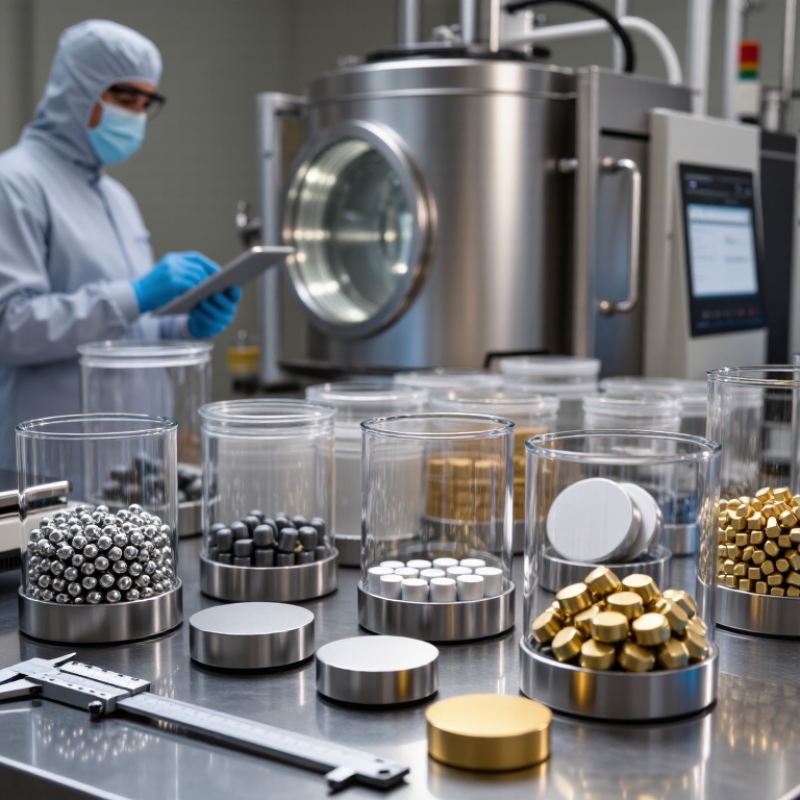
Evaporation materials are solid substances converted into vapor inside a vacuum chamber. The vapor then condenses on a carefully positioned substrate. This process creates thin films for displays, optical parts, sensors, solar devices, and protective coatings.
Common materials include aluminum, copper, gold, silver, nickel, silicon, oxides, and fluorides. They may appear as pellets, granules, wire, or pressed tablets. Each form affects melting behavior, vapor pressure, and deposition stability. A tungsten boat, ceramic crucible, or electron-beam source heats the material. The substrate rotates above it while a thickness monitor tracks film growth. Small details matter. Excessive heating can cause splashing, contamination, or uneven coverage.
When comparing China’s leading evaporation material manufacturers, buyers should examine purity, particle size, packaging, and batch consistency. Certificates should identify composition, impurity levels, and inspection methods. Engineers also need to check compatibility with the chamber, source liner, and target film. In practical testing, an apparently suitable material may release gas during heating. That problem can damage coating uniformity. Pre-baking often helps, but it is not a complete solution. Storage also deserves attention because moisture can change powder behavior and increase outgassing. Careful trial records make supplier evaluations more reliable.
Evaporation materials are solid-source materials heated in a vacuum so that atoms or molecules vaporize and condense as thin films on a substrate. The following table summarizes ten widely used material categories commonly supplied by evaporation-material manufacturers. Manufacturer names and brand-specific data are intentionally omitted.
| Reference | Evaporation Material | Chemical Formula | Melting Point or Thermal Behavior | Common Purity Grade | Typical Product Forms | Common Applications | Key Selection Considerations |
|---|---|---|---|---|---|---|---|
| 01 | Aluminum | Al | 660.3 °C | 99.99%–99.999% | Pellets, pieces, wire, granules | Reflective coatings, electrodes, optical mirrors, barrier films, flexible electronics | High reflectivity, relatively low melting point, and good electrical conductivity |
| 02 | Copper | Cu | 1,084.6 °C | 99.99%–99.999% | Pellets, pieces, wire, slugs | Conductive layers, semiconductor interconnects, electromagnetic shielding, decorative coatings | Excellent conductivity; requires control of oxidation and substrate heating |
| 03 | Silver | Ag | 961.8 °C | 99.99%–99.999% | Pellets, granules, wire, pellets with shaped geometry | Low-resistance electrodes, mirrors, solar cells, transparent-conductive-stack electrodes | Highest electrical conductivity among metals; film adhesion and sulfur resistance may require attention |
| 04 | Gold | Au | 1,064.2 °C | 99.99%–99.9999% | Pellets, wire, granules, formed pieces | Corrosion-resistant contacts, optical coatings, sensors, laboratory and research devices | Excellent chemical stability and conductivity; high material cost |
| 05 | Chromium | Cr | 1,907 °C | 99.95%–99.99% | Pellets, pieces, powder-free granules | Adhesion layers, diffusion barriers, wear-resistant coatings, decorative finishes | High hardness and good adhesion; evaporation requires a higher-energy source |
| 06 | Nickel | Ni | 1,455 °C | 99.95%–99.99% | Pellets, pieces, wire, slugs | Diffusion barriers, magnetic films, protective layers, electronic components | Good corrosion resistance and mechanical stability; deposition rate depends strongly on source design |
| 07 | Titanium | Ti | 1,668 °C | 99.95%–99.99% | Pellets, pieces, wire, rods | Adhesion layers, barrier coatings, optical components, biomedical and aerospace surfaces | Strong adhesion and low density; highly reactive with oxygen and nitrogen at elevated temperature |
| 08 | Tungsten | W | 3,422 °C | 99.95%–99.999% | Pellets, granules, wire, machined pieces | High-temperature electrodes, hard coatings, diffusion barriers, specialized electronic films | Extremely high melting point; generally needs electron-beam or other high-energy evaporation equipment |
| 09 | Molybdenum | Mo | 2,623 °C | 99.95%–99.99% | Pellets, pieces, wire, rods | Electrodes, back contacts, semiconductor coatings, high-temperature thin-film systems | High thermal stability and relatively low vapor pressure; source compatibility is important |
| 10 | Silicon Dioxide | SiO2 | Approximately 1,713 °C; may soften or decompose depending on conditions | 99.99%–99.999% | Granules, tablets, pellets, sintered pieces | Optical antireflection coatings, dielectric layers, insulating films, protective optical surfaces | Deposition chemistry, oxygen partial pressure, and film stoichiometry must be carefully controlled |
They are solid materials heated in a vacuum chamber. Their vapor condenses on a substrate, forming a thin film. These films support displays, optics, sensors, solar devices, and protective surfaces.
Common forms include pellets, granules, wires, and pressed tablets. Shape affects melting behavior and deposition stability. The best form depends on the source and chamber design.
Common choices include aluminum, copper, gold, silver, nickel, silicon, oxides, and fluorides. Different materials provide reflection, adhesion, conductivity, or surface protection.
A tungsten boat, ceramic crucible, or electron-beam source heats the material. The substrate often rotates above the source. A thickness monitor tracks film growth during deposition.
Review purity, particle size, packaging, batch consistency, and technical support. Request samples and compare results under identical vacuum conditions. Promotional claims are not enough.
Ask for a certificate of analysis, safety data sheet, lot number, and traceability records. Useful documents also describe impurities, dimensions, inspection methods, and melting data.
Not always. Decorative coatings may not require the highest purity grade. Sensitive vacuum systems usually need cleaner materials with lower gas release and stable evaporation rates.
Moisture can change powder behavior and increase outgassing. Pre-baking may help, but it is not a complete solution. Excessive heating can cause splashing or uneven coverage.
Check crucible compatibility, chamber pressure, deposition rate, and substrate temperature. Record film color, adhesion, thickness, and surface appearance. Results may vary between batches.
A supplier can look excellent on paper. That still proves little. Inspect testing equipment, response times, packaging cleanliness, and long-term batch records before committing.
This article provides a practical overview of Evaporation Materials, explaining how they are transformed into thin films through controlled heating and deposition processes. It introduces their role in industries such as semiconductor manufacturing, display production, optical coating, solar energy, and precision electronics, while highlighting the importance of material purity, evaporation performance, thermal stability, and compatibility with different equipment.
The article also examines how China’s Evaporation Materials industry is organized, from raw material processing and formulation to quality inspection and technical support. It presents a framework for evaluating leading manufacturers based on production capabilities, research strength, consistency, certifications, customization services, and delivery reliability. In addition, the guide summarizes major product categories, typical applications, relevant quality standards, and key purchasing considerations, including purity levels, material specifications, packaging, batch traceability, technical assistance, and total procurement cost. This information helps international buyers compare suppliers more efficiently and select suitable materials for their specific deposition requirements.

 Zongheng