Evaporation Film is created by turning a coating material into vapor and condensing it onto a moving film inside a vacuum chamber. The result can be a thin, reflective layer, often aluminum, or a transparent barrier coating. It is not one single product. The substrate, coating material, thickness, and deposition settings all affect how the finished film performs.
The market context is substantial. Smithers’ report, The Future of Global Flexible Packaging to 2028, valued the global flexible-packaging market at about US$293.7 billion in 2023 and forecast further growth. That figure covers flexible packaging broadly, not evaporation-coated films alone. Still, it helps explain why lightweight films with useful barrier properties attract attention. In a package, a coating only a fraction of a micrometre thick can help limit exposure to light, oxygen, or moisture.
The main types include vacuum-metallized PET, BOPP, CPP, and polyethylene films. Aluminum coatings provide a bright, opaque surface; aluminum-oxide and silicon-oxide coatings can offer transparent barrier options. Each suits different needs. A snack wrapper may prioritize light protection and appearance, while a clear pouch may need visibility. Vacuum-coating researcher Donald M. Mattox’s published work on physical vapor deposition emphasizes how process conditions shape deposited-film structure. That is a useful reminder, not a product guarantee. Thin layers can be sensitive. Small variations in tension, temperature, or coating uniformity may change performance, and “barrier film” does not mean identical protection in every application.
Definition and Basic Principles of Evaporation Film
What Is Evaporation Film and What Types Are Available?
Definition and Basic Principles of Evaporation Film
Evaporation film is a thin layer created when a solid material becomes vapor and settles onto a surface. The surface may be polymer film, glass, paper, or metal. This process usually occurs inside a controlled vacuum chamber.
Heat changes the coating material into vapor. The vapor then travels through the chamber and condenses on the cooler substrate. That is the basic principle. Film thickness depends on evaporation speed, exposure time, and substrate movement. Even small changes can affect performance.
In practical production, operators monitor pressure, temperature, and coating rate. A clean surface is essential. Dust can create pinholes, weak adhesion, or visible marks. The finished film may improve light reflection, electrical conductivity, moisture resistance, or barrier performance. Different materials create different results. Metallic coatings often provide a reflective appearance, while oxide coatings can offer transparency and protection.
Available types include single-layer films, multilayer films, transparent films, and reflective films. Some are designed for flexible packaging. Others support electronic components, optical parts, or decorative surfaces. The word “film” can be misleading. It is not always soft or flexible. A very thin coating may be brittle on glass but durable on plastic.
No coating process is perfectly uniform. Edges may receive slightly different coverage. This is easy to overlook during laboratory testing. Careful inspection remains necessary before large-scale use. Performance also depends on storage, handling, and the final application environment.
Main Materials Used in Evaporation Film Production
Main Materials Used in Evaporation Film Production
Evaporation film starts with a flexible base layer, often polyethylene terephthalate (PET), polypropylene, or nylon. Each material behaves differently under heat and tension. PET offers dimensional stability, while polypropylene can provide a lightweight, moisture-resistant structure. Nylon is often selected when toughness matters. The right choice depends on packaging needs, sealing conditions, and the product inside.
A very thin coating is then deposited onto the substrate in a vacuum chamber. Aluminum is widely used because it creates a reflective, light- and moisture-blocking surface. For applications requiring transparency, manufacturers may use deposited aluminum oxide or silicon oxide instead. These coatings can improve barrier performance, but they are not interchangeable; performance depends on coating thickness, film design, and handling. Small defects matter.
Additional layers may include primers, protective lacquers, or sealable coatings. They help the deposited layer bond, resist abrasion, or form a reliable seal during packaging. In practice, the stack is a compromise: increasing barrier performance may affect flexibility, appearance, or recyclability. That trade-off deserves careful testing. A clear sample can still have a complex structure. Testing the finished film under real storage and sealing conditions is more useful than relying on material names alone.
Key Types of Evaporation Film and Their Differences
What Is Evaporation Film and What Types Are Available?
Evaporation film is a thin coating created by heating a solid material inside a vacuum chamber. The vapor travels toward a cooler substrate and forms a controlled layer. This process supports optical filters, reflective surfaces, sensors, and protective components. Film performance depends on thickness, material purity, substrate temperature, and adhesion.
Key Types of Evaporation Film and Their Differences
Metal films usually provide strong reflection and electrical conductivity. Aluminum-like materials are common for visible-light reflectors, while other metals suit infrared or electrical applications. Dielectric films behave differently. They can transmit selected wavelengths, reduce glare, or protect an underlying layer. Their optical response changes with thickness, density, and refractive index.
Compound films contain materials such as oxides, fluorides, or nitrides. They often offer better chemical stability than simple metal layers. Multilayer films combine several materials to create sharper optical control. A technician may alternate high-index and low-index layers, like carefully stacked glass sheets. Thermal evaporation is relatively simple and cost-effective. Electron-beam evaporation can handle materials requiring higher temperatures and may improve deposition control.
The best choice is rarely universal. A reflective coating may fail when moisture reaches a poorly prepared surface. Adhesion testing, thickness checks, and witness samples reveal problems before full production. Small variations can matter. In practice, coating design sometimes needs revision after testing, especially when the substrate expands differently from the film.
Manufacturing Process and Performance Characteristics
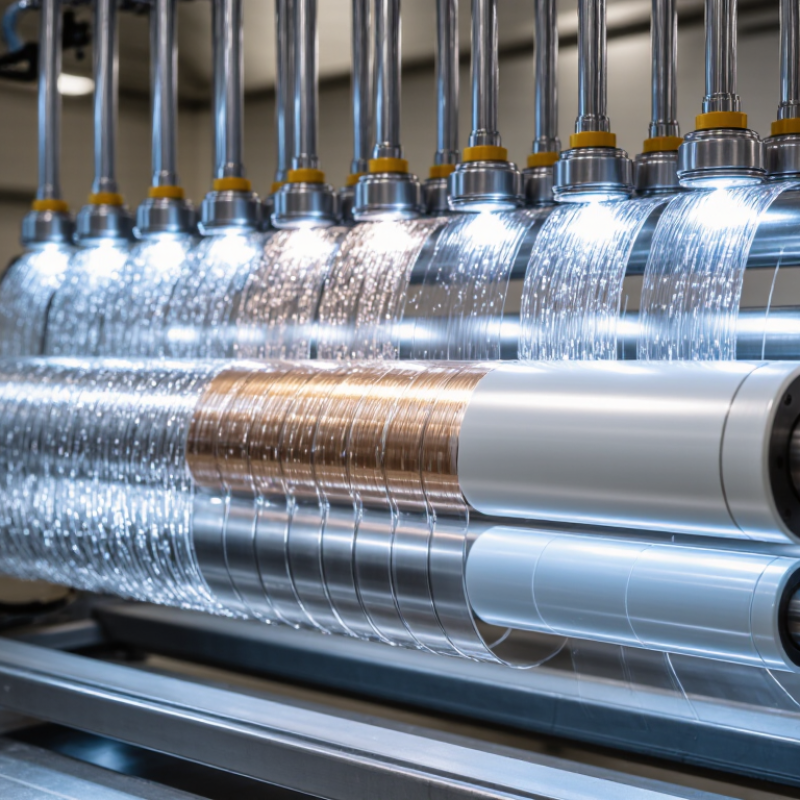
Evaporation film is made by depositing vaporized material, usually aluminum, onto a moving plastic web inside a vacuum chamber. The web unwinds, passes through surface treatment, and travels past a heated evaporation source. Cooling rollers help stabilize it before rewinding. Small process changes matter. Tension, chamber pressure, and deposition rate can affect coating continuity and appearance.
AIMCAL’s technical guidance describes common aluminum coatings as roughly 20–50 nanometers thick—far thinner than a human hair. That thin layer can improve light, oxygen, and moisture barriers, but pinholes and wrinkles may reduce performance. Substrate choice matters too: PET often provides stiffness and heat resistance, while flexible polyolefin films can suit different sealing needs.
ASTM F1249 and ASTM D3985 provide established methods for testing water-vapor and oxygen transmission, respectively. A shiny surface is not proof of a strong barrier. Test the finished laminate under its intended humidity and temperature; results can differ from flat-film measurements. Even experienced converters can miss weak spots.
Common Applications and Selection Considerations
Evaporation film describes the thin liquid layer formed on a heated surface as water or another solvent vaporizes. In industrial equipment, common designs include falling-film, rising-film, and wiped-film evaporators. Falling-film units spread liquid down vertical tubes, while wiped-film systems use rotating blades to keep heat-sensitive material moving. The right design depends on viscosity, temperature sensitivity, and the desired concentration—not just throughput.
Applications include concentrating fruit juice, dairy ingredients, plant extracts, and wastewater streams. The International Energy Agency’s Energy Efficiency 2023 report notes that industry accounts for about 37% of global energy use. That makes heat recovery and efficient operation worth evaluating, though the figure covers industry broadly, not evaporation equipment alone. For food products, look for hygienic surfaces and cleanable layouts. For viscous or heat-sensitive liquids, a wiped-film design may reduce hot-surface exposure. It is not automatically the best choice; maintenance and feed behavior matter too.
Compare operating temperature, vacuum needs, residence time, corrosion resistance, and cleaning requirements. Ask suppliers for performance data using a feed similar to yours, since water-only tests can mislead. Check material compatibility, fouling risk, and expected product quality. A compact unit may save floor space, but tight passages can be harder to clean. Pilot testing helps. So does a little skepticism.
What Is Evaporation Film and What Types Are Available?
Evaporation film is a thin coating deposited by vaporizing a solid material in a vacuum and condensing it onto a substrate. The chart compares the melting points of commonly used evaporation-film materials, which helps indicate the thermal energy required during deposition.
Common Film Types and Applications
| Material |
Typical Film Characteristics |
Common Applications |
| Aluminum |
High visible reflectivity, low density, good electrical conductivity |
Reflective coatings, packaging, electronic conductors |
| Silver |
Very high visible and infrared reflectivity |
Optical mirrors, sensors, conductive layers |
| Gold |
Excellent chemical stability and infrared reflectivity |
Optical filters, electronics, decorative coatings |
| Copper |
High electrical and thermal conductivity |
Circuit layers, electromagnetic shielding, heat-transfer components |
| Chromium |
Hard, wear-resistant, and strongly adherent when properly deposited |
Decorative coatings, tooling, wear-resistant surfaces |
Material selection should consider the required optical or electrical performance, substrate temperature limits, adhesion, chemical stability, film stress, deposition rate, and total cost. Melting point is only one process indicator; the final film properties also depend on vacuum level, deposition rate, substrate preparation, and film thickness.
Conclusion
Evaporation Film is a thin material created by depositing a substance onto a surface through evaporation, forming a uniform layer with carefully controlled properties. Its performance depends on factors such as the base material, coating composition, thickness, and production conditions. Common materials include polymer substrates and deposited metals or other functional compounds, selected to provide qualities such as transparency, reflectivity, barrier protection, or electrical conductivity.
Different types of Evaporation Film are designed for distinct performance needs, and their properties can be adjusted during manufacturing by controlling the deposition process and layer structure. These films are used in areas such as packaging, optical components, electronics, and decorative finishes. When choosing a type, consider the intended application, required durability, flexibility, appearance, environmental conditions, and compatibility with other materials. Matching these factors helps ensure the film delivers reliable performance for its intended purpose.

 Zongheng