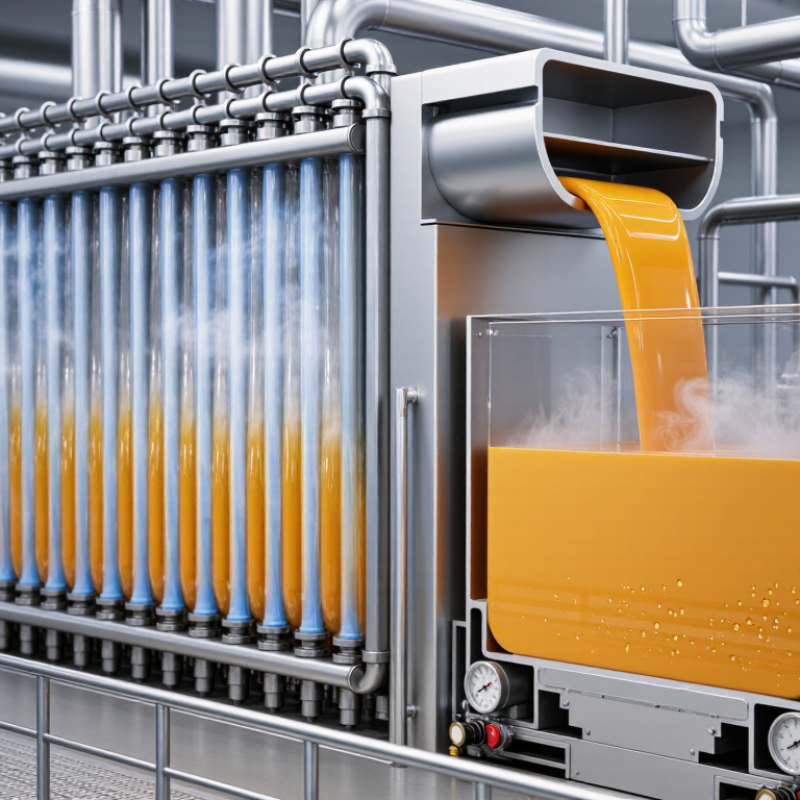
Understanding how a falling film evaporator operates is essential for engineers, plant operators, and process designers working with heat-sensitive liquids. This equipment spreads a thin liquid film over heated tube walls, allowing rapid evaporation with limited residence time. The Falling Film Evaporator Working Principle depends on gravity, controlled liquid distribution, heat transfer, and vapor separation. Picture juice entering the top of a vertical tube bundle. It flows downward as a thin, continuous layer while steam heats the opposite tube surface. Water vapor forms along the path and exits through a separate vapor channel.
Small details matter. Poor distribution can leave dry patches, while excessive feed can reduce evaporation efficiency. Vacuum operation may lower the boiling temperature, protecting flavors, nutrients, and other sensitive compounds. Real performance also depends on feed viscosity, fouling tendency, steam pressure, and cleaning practices. Numbers from a brochure cannot replace operating data.
This guide explains the main components, heat and mass transfer steps, and practical control points behind the process. It also considers common design limitations, including uneven wetting and unstable film flow. These issues are often underestimated. A reliable explanation should connect theory with what operators observe: rising pressure drop, changing condensate temperature, or deposits inside tubes. Manufacturer manuals, validated calculations, and plant measurements should support final decisions. The principle looks simple. The process is not. Understanding that difference helps readers evaluate equipment more safely, compare designs fairly, and improve evaporation performance without relying on assumptions.
What Is a Falling Film Evaporator?
A falling film evaporator is a heat-transfer system that removes water or another volatile liquid from a solution. The feed enters at the top and spreads across heated tubes as a thin, continuous film. Gravity pulls the liquid downward. Heat passes through the tube walls, causing part of the liquid to evaporate. The vapor then separates from the concentrated liquid in a lower chamber.
This design uses a short residence time. That matters when processing heat-sensitive products, such as dairy liquids, fruit extracts, or pharmaceutical solutions. A thin film also improves heat transfer because the distance is small. In practice, even distribution is critical. Poor spreading can create dry spots, scaling, or uneven concentration. I have found that small flow changes can affect performance more than expected. That is why operators should monitor feed temperature, vacuum level, pressure drop, and outlet concentration.
Tips: Keep the distributor clean. Check spray patterns regularly. Control the feed rate carefully. A sudden increase may flood the tubes, while a low rate can break the film. Use verified instruments, not assumptions. Product viscosity, fouling tendency, and boiling-point rise must guide the design. Laboratory results may not fully predict industrial behavior, so pilot testing remains valuable. A falling film evaporator is efficient, but it is not automatically maintenance-free.
In a falling film evaporator, liquid enters a distribution chamber above the heating tubes. A distributor spreads it across each tube entrance. Gravity then pulls the liquid downward as a thin, continuous film. The film should touch the tube wall evenly. Dry patches can quickly reduce heat transfer.
Steam or another heating medium surrounds the tubes. Heat passes through the tube wall and warms the descending liquid. As the liquid travels, part of its solvent evaporates. Vapor moves toward a separator, while concentrated liquid continues downward. Operators often check flow pressure, feed temperature, and outlet concentration. These readings reveal whether the film is stable. Uneven flow remains a common weakness, especially when distributors become blocked or poorly adjusted.
Tips: Keep the feed distributor clean and inspect spray holes during maintenance. Confirm that every tube receives liquid before increasing heat input. A simple visual test can expose dry tubes. Watch for rising pressure drop, unusual vibration, or changing product color. These signs may indicate fouling or poor wetting. Do not assume a higher feed rate improves performance. Excess liquid can thicken the film and reduce evaporation efficiency. On the other hand, very low flow may leave sections partly dry. The correct operating range depends on viscosity, temperature, vacuum, and tube design. Small adjustments matter. Still, operating data should guide every adjustment, because a setting that works today may fail after concentration changes.
A falling film evaporator spreads liquid into a thin film along heated tubes. Gravity pulls the liquid downward while heat moves through the tube wall. The heating medium condenses outside the tubes, releasing latent heat. Inside, the liquid warms quickly and begins to vaporize. As pressure decreases, its boiling temperature also drops. This allows evaporation at lower temperatures, which helps protect heat-sensitive products.
Heat transfer depends on film thickness, flow distribution, temperature difference, and surface condition. A thin, even film exposes more liquid to the heated wall. Vapor bubbles form, expand, and separate from the concentrated liquid. Proper vapor removal prevents pressure instability and reduces entrainment. In plant operation, small flow changes can create dry patches. That detail is easy to miss. The theory looks clean; real operation rarely does. Fouling, non-condensable gases, and uneven feeding may reduce performance. Operators should check outlet concentration, pressure, and temperature together, not separately.
Tips: Keep the feed distributor clean. Confirm stable vacuum conditions. Watch for rising pressure drop. Inspect tube surfaces when capacity slowly declines. A practical test with clean water can reveal poor distribution, although it cannot represent every product.
2026 How to Understand Falling Film Evaporator Principle?
How Are Vapor and Concentrated Liquid Separated?
A falling film evaporator spreads feed liquid across the tops of vertical heating tubes. A distributor must wet each tube evenly. Otherwise, dry patches can appear and reduce heat transfer. The liquid then flows downward as a thin film. Heating steam condenses outside the tubes, while water inside the film changes into vapor. Thin films shorten residence time. This helps protect heat-sensitive liquids.
At the tube outlets, vapor and concentrated liquid enter a separator. Their velocities decrease inside the chamber. The heavier liquid falls into the lower collection section, while vapor rises toward the outlet. A demister can capture fine droplets carried by the vapor. This detail matters. Without effective droplet removal, valuable solids may leave with the vapor stream.
Operators usually control pressure, feed rate, temperature difference, and liquid distribution together. A higher pressure can raise the boiling temperature. That may be unsuitable for sensitive products. In real operation, separation is rarely perfect. Foaming, entrainment, and unstable feed conditions can disturb the boundary between phases. The process diagram looks simple. The equipment is not. I would also question any calculation based only on ideal flow, because fouling can gradually change film behavior and separator performance. Regular inspection of tube wetting, vapor outlets, and liquid concentration provides more reliable evidence than temperature readings alone.
2026 How to Understand Falling Film Evaporator Principle?
A falling film evaporator distributes liquid across heated tubes. Gravity pulls the liquid downward as a thin film. Steam condenses outside the tubes and transfers heat through the metal wall. Thin films improve heat transfer and reduce residence time. However, performance depends on more than the basic principle. The IEA Energy Efficiency 2023 report states that industry consumed about 37% of global final energy in 2022. Evaporation efficiency therefore deserves close attention.
Feed distribution is a critical factor. Poor wetting creates dry patches, overheating, and unstable product quality. Feed temperature also matters because colder liquid consumes more steam. Vacuum pressure controls boiling temperature and available temperature difference. Higher temperature differences can increase capacity, but they may accelerate fouling or damage heat-sensitive materials. The European Commission’s 2019 BAT Reference Document identifies multiple-effect evaporation and vapor recompression as established energy-saving measures. Typical engineering references report steam economies near 0.8–1.0 in single-effect units and roughly 2.0–2.5 in three-effect systems.
Fouling remains the quiet problem. A thin mineral layer adds thermal resistance and reduces output. Non-condensable gases can block heat-transfer surfaces, even when steam pressure appears normal. In plant reviews, operators often trust design calculations too much. That assumption is risky. The U.S. Department of Energy’s steam-system guidance emphasizes regular measurement of pressure, temperature, condensate, and leakage. I would also track film wetting visually, because instruments can miss local dry zones. Some designs look efficient on paper. Reality is less obedient.
In a falling film evaporator, liquid flows as a thin film down heated tubes while part of the solvent evaporates. The chart shows representative heat-transfer performance as the effective boiling temperature difference increases. Heat flux is calculated from q = U × ΔT, using typical overall heat-transfer coefficients for aqueous falling-film operation. Higher temperature difference generally increases evaporation capacity, while viscosity, fouling, poor liquid distribution, and insufficient wetting can reduce actual performance.
It removes water or another volatile liquid from a solution. Feed enters at the top and flows downward inside heated tubes. Gravity keeps the liquid moving as a thin film. Heat creates vapor and a more concentrated liquid.
A thin film transfers heat efficiently and reduces residence time. This can protect dairy liquids, fruit extracts, and pharmaceutical solutions. The benefit is not automatic. Poor wetting can still cause overheating.
Both streams enter a lower separator at reduced velocity. Heavier liquid falls into a collection section. Vapor rises toward the outlet. A demister can catch fine droplets. Without it, valuable solids may escape.
Some tubes may develop dry patches. Heat transfer then falls, and local overheating or scaling may occur. Outlet concentration can become uneven. Check the distributor and spray pattern regularly.
Track feed temperature, feed rate, vacuum level, pressure drop, and outlet concentration. Watch tube wetting when possible. A sudden feed increase may flood tubes. A low rate may break the film. Small changes matter.
Pressure influences boiling temperature and the available temperature difference. Higher pressure can raise the boiling temperature. That may harm sensitive liquids. Vacuum control needs verified instruments, not assumptions.
Multiple effects and vapor recompression can improve steam economy. Single-effect units often consume more steam per kilogram of water removed. Actual savings depend on fouling and feed conditions. The calculation may look better than the plant.
Mineral deposits add resistance between steam and liquid. Non-condensable gases can also block heat-transfer surfaces. Output may decline while pressure readings seem normal. Clean surfaces and inspect condensate paths.
It is valuable when viscosity, fouling, or boiling-point rise is uncertain. Laboratory results may not predict industrial behavior accurately. Pilot tests reveal distribution and separation problems earlier. Some surprises remain.
A Falling Film Evaporator is a heat-transfer system designed to remove water or other volatile components from a liquid solution efficiently. Its Falling Film Evaporator Working Principle begins when the feed liquid is distributed evenly across the inner surfaces of vertical heating tubes. As gravity pulls the liquid downward, it forms a thin, continuous film rather than filling the tubes completely. This design creates a large heat-transfer area and reduces the time the liquid remains exposed to heat.
When steam or another heating medium warms the outside of the tubes, the liquid film absorbs heat and partially vaporizes. The generated vapor moves separately from the increasingly concentrated liquid, while internal separators or external chambers help prevent liquid droplets from being carried away. The final performance depends on factors such as feed distribution, heating temperature, vacuum level, liquid viscosity, flow rate, tube cleanliness, and the desired concentration. Proper control of these conditions can improve evaporation efficiency, product quality, and energy use.

Zongheng